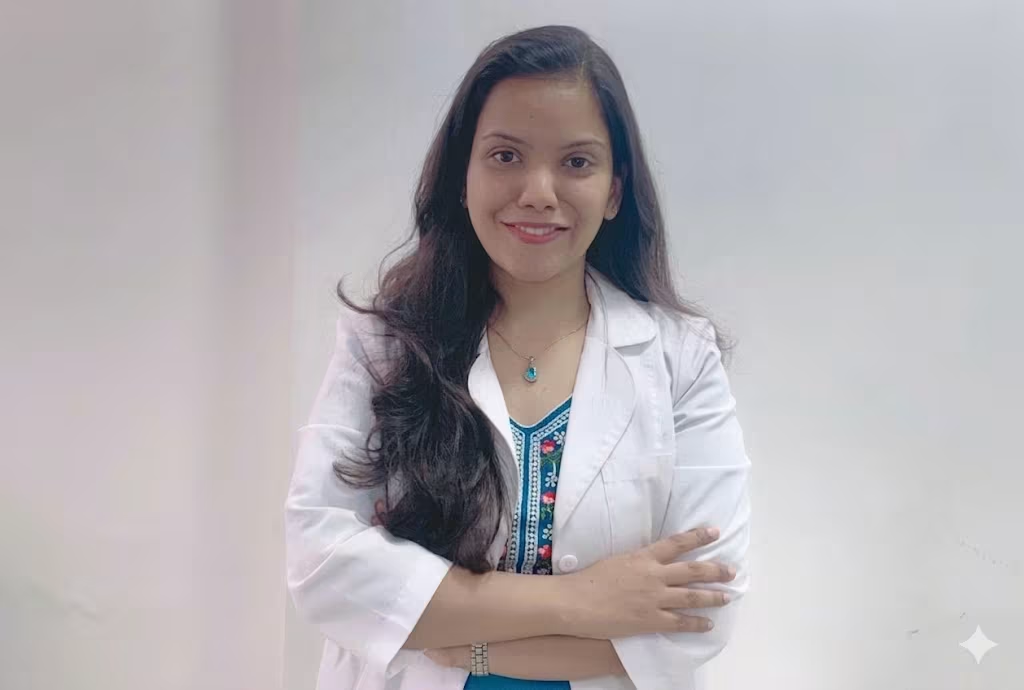
Our Patient. 26. Bangur Nagar, Goregaon West.
She had grown up in Goregaon West — the kind of neighbourhood where everyone knows the family panwala, where festivals spill into the street and every occasion calls for a photograph. She had been in more photographs than she could count. In almost none of them was she genuinely smiling.
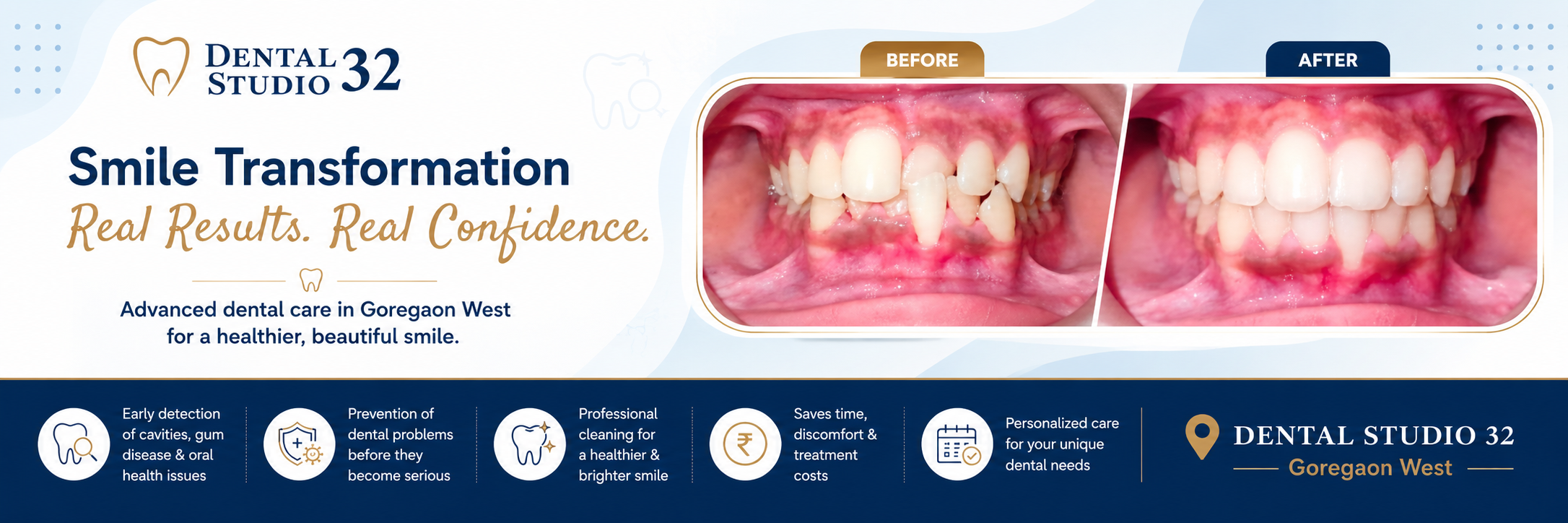
Her teeth had been heavily crowded since her early teens. The upper front teeth overlapped significantly, one tooth rotated and pushed forward, giving her bite a compressed, uneven look. A lower canine sat entirely out of line with the rest. When she smiled wide, the effect was one she had decided, somewhere around age fourteen, she would simply not show the world. So she didn't.
"I became very good at the closed-mouth smile," she told us at her first visit to our clinic in Goregaon West. "People always said I looked serious. That wasn't it. I just wasn't going to open my mouth."
"People always said I looked serious in photos. That wasn't it. I just wasn't going to open my mouth."Our patient, 26 — Bangur Nagar, Goregaon West
The Moment That Brought Her In
What finally brought her to a dentist in Goregaon West wasn't frustration or a sudden change of heart. It was a wedding — her own, planned for eighteen months later.
Her mother had been saving a particular photograph from their home in Bangur Nagar for years: a photo of her at age six, laughing with her whole face, completely unselfconscious. "My mother showed it to me and asked when she last saw me smile like that. I didn't have an answer." That conversation happened on a Tuesday. She came to Dental Studio 32 the following Saturday.
She was nervous. She had visited one other clinic in the area two years earlier and been given a quote and a date without a single explanation of what would happen, why, or how long it would take. She had left without making an appointment and hadn't gone back. What she needed — before a treatment plan, before anything — was to simply understand what was possible and what it would involve.
💡 A note from Dr. Stutee: This patient's experience is more common than patients realise. Many people in Goregaon West have lived with dental concerns for years — not because treatment wasn't available, but because no one had taken the time to sit with them and explain what the journey would actually look like. That conversation is always where we begin. No clinical notes, no quote, no treatment start — just a proper understanding of the person and what they are hoping for.
The Clinical Picture — What We Were Dealing With
When Dr. Stutee examined her teeth and reviewed her digital X-rays and bite scan at our consultation and diagnostics appointment, the clinical picture was detailed but not unusual. Heavy crowding in both arches, a significantly rotated upper lateral incisor, a displaced lower canine, and a mild deep bite — where the upper front teeth overlapped the lower ones further than they should.
What made this case worth documenting is not that it was especially complex — it wasn't. What makes it worth sharing is that it represents a very specific kind of patient: someone who had a genuine, treatable problem and had been quietly carrying it for over a decade because no one had ever clearly mapped out what treatment would involve or look like.
The Challenges
Severe upper arch crowding with a rotated lateral incisor. Displaced lower canine. Mild deep bite requiring careful management. Patient had significant anxiety from a previous clinic experience. Wedding timeline of 18 months as a firm anchor point for completion.
What Made It Workable
Good bone structure and healthy gum tissue. No previous dental work complicating the orthodontics. Strong patient motivation and reliability for appointments. Eighteen months was a realistic timeline for this case — not rushed, not extended.
After the clinical assessment, Dr. Stutee spent time going through each finding with her — not in abstract clinical terms, but in plain language. What was crowded and why. What the treatment would move and in what order. What she would see at each stage, including the intermediate stages that often look worse before they look better. That last part mattered enormously. Patients who understand that teeth can appear to worsen in appearance mid-treatment before they improve are far more likely to stay the course — and far less likely to panic when, around month three, something looks temporarily more uneven than it did at the start.
The Journey — Month by Month
Orthodontic treatment is not an event. It is a process measured in months — and for patients in Goregaon West who have never experienced it, that rhythm can feel unfamiliar at first and then, quite quickly, become simply part of life. Her journey over seventeen months looked like this.
Records, Planning and the First Brackets
Digital impressions, full records, and the treatment simulation were completed. Ceramic braces were chosen — our patient worked in a client-facing marketing role and preferred the least visible option that still gave full control over complex movements. Bracket bonding took just under ninety minutes. She left that afternoon with her treatment officially underway.
The Alignment Phase — The Hard Part
The early months of orthodontics are the most psychologically demanding. The teeth are being moved from significantly crowded positions, which means some gaps open temporarily before closing. She came in at month three concerned that one space between her front teeth had widened noticeably. This was exactly as planned — a necessary step before the final alignment. Understanding this in advance made all the difference. She continued without interruption.
Space Closure and the Canine
The displaced lower canine required its own sequence of movements — brought into alignment gradually before the surrounding teeth were positioned around it. By month eight, both arches were showing substantial improvement. She had been photographing her progress in the same mirror position every month, and sent us a message after her month-eight appointment: "I caught myself smiling at my reflection this morning. First time in years."
Bite Correction and Detailing
The deep bite required specific wire mechanics and bite ramps over several months. This phase looks the most unremarkable from the outside — the teeth appear largely aligned — but it is where the bite geometry is being corrected for long-term function. Getting the bite right is what ensures the result lasts. Aesthetics without a stable bite is a result that unravels.
Debond, Retainers and the First Open Smile
Brackets were removed eleven weeks before the wedding. Fixed retainers were bonded behind the upper and lower front teeth, and removable retainers were made for nighttime use. A professional cleaning and polishing completed the appointment. She asked for a hand mirror before she left the chair. She held it for a long moment. "This is my actual smile," she said. "I haven't seen this."
The Outcome — In Numbers and in Words
The clinical outcomes were exactly as planned: full arch alignment, the rotated lateral incisor brought into position, the canine corrected, and the deep bite resolved. The bite is now stable. The retainers — both fixed and removable — will maintain that stability long-term.
But the clinical outcome is not the story. The story is our patient at her wedding reception in Goregaon West, in a hall she had booked three years earlier, surrounded by her family from Bangur Nagar — laughing with her whole face, completely unselfconscious. Her mother showed us the photograph later. Same expression. Same light in the eyes. Same smile as the six-year-old in that old photograph from home.
"My mother cried when she saw my wedding photos. Not because the wedding was emotional — but because she finally saw my real smile again after twenty years."Our patient, post-treatment — Bangur Nagar, Goregaon West
What Made This Treatment Successful
Cases like this are not rare at our dental clinic in Goregaon West. What is sometimes rare is the combination of elements that allows them to go smoothly — and those elements are worth naming clearly for anyone else considering orthodontic treatment.
Realistic Timeline, Set Upfront
Our patient had a wedding. That date was fixed and known from the start. Treatment was planned backwards from that anchor point with buffer — completing two months early, not rushing to finish. A clear timeline set at the beginning is a gift to the patient and the clinician.
Preparation for the In-Between
Knowing that teeth look temporarily worse before they look better is one of the most valuable things an orthodontist can tell a patient. She had this conversation at visit one. She was never alarmed by mid-treatment appearances because she had been told exactly what to expect.
Consistent Appointments
Orthodontic progress depends entirely on regular adjustment appointments. She missed one appointment in seventeen months — and called the clinic before missing it. Every patient who treats their adjustment visits seriously shortens their treatment by months.
Bite Correction as a Priority
Straight teeth on a misaligned bite is an unstable result. The final months of treatment focused almost entirely on bite geometry — the work that does not show in mid-treatment photographs but determines whether the result lasts five years or twenty-five.
Does This Sound Familiar?
Priya's story is specific to her — but the underlying experience is not. In thirteen years of treating patients at our dental clinic in Goregaon West, Dr. Stutee has seen this pattern repeatedly: a person who has lived quietly with a dental concern for years, not because they don't want to address it, but because no one has ever taken the time to clearly map out what the journey involves.
If you have crowded, gapped, or misaligned teeth — if you recognise the closed-mouth smile, the hand over the mouth, the turning away from cameras — you may be a strong candidate for orthodontic treatment in Goregaon West. And the treatment is more manageable than most people expect when it is explained properly, planned realistically, and carried out with precision.
The right starting point is a proper clinical assessment. Not a quote. Not a date. A conversation about what is actually happening with your teeth, what the options are, and what the journey looks like — with enough specificity that you leave understanding, not overwhelmed.
That conversation is the first step at Dental Studio 32. It is where every successful treatment begins.